
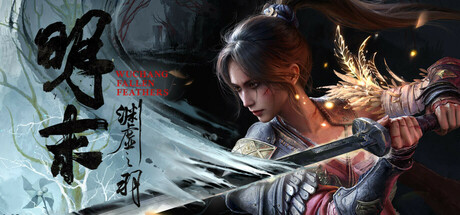
WUCHANG: Fallen Feathers
An action RPG attempting to imitate Soulslike games, set in the late Ming era. Though Sichuan dialect voice acting is a major feature, core mechanics, technical optimization, and artistic presentation all appear rough, failing to form its own characteristics.
Art Appreciation
Rating Breakdown
Deductions
Soulslikes have been popular in recent years, but this game's art and mechanics, on every level, imitate the Souls series crudely, with no highlights of its own.
For a Souls-style game, combat is the core gameplay, but the hits lack impact and combos don't flow well; overall it's mediocre.
Mouse sensitivity is too high; even when locked on during a string of attacks, I often lose track of where the camera has drifted, and attacking during a conversation interrupts it. Camera movement is also on the fast side and often feels shaky, so much so that I, someone who has never gotten 3D motion sickness, had some motion-sickness-like symptoms in this game.
The only somewhat unique design is the invisible bridge, but it's quite jarring: it first appears at the Taoist temple and then stays as a mechanic you're supposed to know, yet logically it doesn't connect at all.
Deductions
Launched on PC with very poor optimization.
Launched on PC with fairly slow loading.
Deductions
The environments have ideas overall but are fairly rough; for example, Buddhist and Taoist murals, grottoes and other elements that could have highlighted the historical setting are clearly not refined enough.
In many scenes, such as climbing stairs outdoors, the sky is full of noise and the image is often blurry.
Boss fights are the main event, yet their models aren't refined enough.
There's basically no facial detail at all; very wooden.
Highlights
The Sichuanese voice acting is a major feature, though its quality is merely middling.
Deductions
Although the story gradually uncovers the heroine's origins, she herself isn't fully characterized.
The way you're guided into Chapter 4 is strange, making it easy to miss important side quests.
The four endings don't really differ much at their core, so they don't do much to motivate replays. The Bo people ending would score a lot more if it added deeper content woven into the story.
A stretch to bring this up under translation, but as a native Sichuanese speaker, some of the text's "Sichuanese localization" isn't quite right.
Deductions
Not much content to explore on your own or unique gameplay.
Not many interesting side quests; the two important ones are really semi-main quests that affect the ending.
The overall story is fairly short and simple, with lots of mystification, yet in the end it leaves nothing to chew on.
Same as the ending handling.
No particularly noticeable New Game Plus elements or positive feedback.
Basically no collectible system worth praising.
The game's historical research is actually quite good, but not letting the Qing forces appear is a real design regret. Besides, for a game whose title explicitly names the "late Ming", not seeing a single Qing soldier is indeed odd. And because it didn't treat both sides evenhandedly on this point, it drew negative reviews in the Chinese player community.