
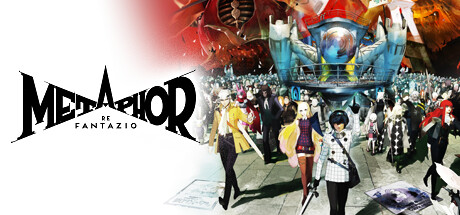
Metaphor: ReFantazio
A new fantasy RPG developed by Atlus, set in a medieval restoration background. Though overall quality is excellent, maintaining Atlus's consistently high standards, innovation is lacking, more like 'reskinned Persona'. Complete worldview, rich content.
Art Appreciation
Rating Breakdown
Deductions
Dungeon design is a big step down from P5; it lacks all the wildly imaginative concepts of inner worlds, and many maps look alike.
However much I play, it just feels like a reskinned Persona. Why not just make P6? Launching a new IP really seems pointless.
The developers said there would be no romance in this game, so the bond system is a lot duller. Their reasoning is that it's a medieval setting and a story about restoring a kingdom, unlike Persona's urban setting, so romance doesn't fit. That doesn't hold up; a prince needs a queen too.
Highlights
Low-level enemies can be killed instantly without entering turn-based combat, which saves a lot of tedious time.
Deductions
The PC version has resolution problems; it's a widespread issue, and every player is searching for a fix.
Deductions
The classical music is well produced and grand and fits the story's setting, which would be great, except the same piece is used in far too many scenes where it doesn't fit, to the point of dragging down the experience. It backfires a bit.
Similar to the music problem, it's too flashy, a bit overdone; in the first battle I couldn't even find what to click in that riot of colors on the UI.
Everyone knows Atlus's anime cutscenes are made by real anime studios, but surprisingly the animation quality here is a step down from P5. Is it because of outsourcing?
Highlights
What I told a friend about my first impression: "Atlus at a glance."
Some say the Human designs are sanity-draining; to me they just had a strong Hajime Isayama vibe. Only later did I learn it wasn't Isayama at all: they all come from Hieronymus Bosch's paintings, lifted directly, since those images are already in the public domain.
Deductions
The prince himself, or rather the protagonist, isn't well developed: all the way through, he carries that utopian novel and talks about his ideal of racial equality, and that's it; you can't dig out any other personality traits. The main villain's ideals are also extremely stubborn and immovable. Midway I even thought there'd be a big twist revealing he wasn't the real villain, but no, he just carries out his stubborn ideals with total purity.
Because of the story's wild twist, the party's motivation in the middle stretch is a bit murky. They forcibly back the protagonist, who isn't yet the prince at that point, as the prince, just to win the royal tournament. It's true they enter to get close to Louis and build popularity, but suppose the protagonist became king while not the prince; he's the prince's loyal retainer, so would he then have to hand the throne over to the prince? The party members' stakes are laid out clearly enough, but whether their motivation is to win the throne or to restore the prince to it is a bit of a tangle.
Highlights
Actually the story takes a wild twist: there's no epic feel of a kingdom-restoration tale, because it turns out I'm the prince himself. But that's not really a minus; it's quite fresh.
The premise is a bit bizarre: to showcase "democracy" in a medieval setting, they invent the concept of royal magic and face stones, which is pretty funny. After all, once you have magic you can make up anything, and they did manage to make the story hold together.
It builds its own "fantasy" world with different tribes and a balance of power among the royal family, the state church and other factions, creating a very complete and fairly interesting world.
Highlights
This is Atlus's home turf; I couldn't help wandering around to see what's everywhere.